 EquipLoop
What is Equipment Management?
What is equipment management? It connects equipment records, handovers, maintenance and lifecycle decisions. See a practical EquipLoop example.
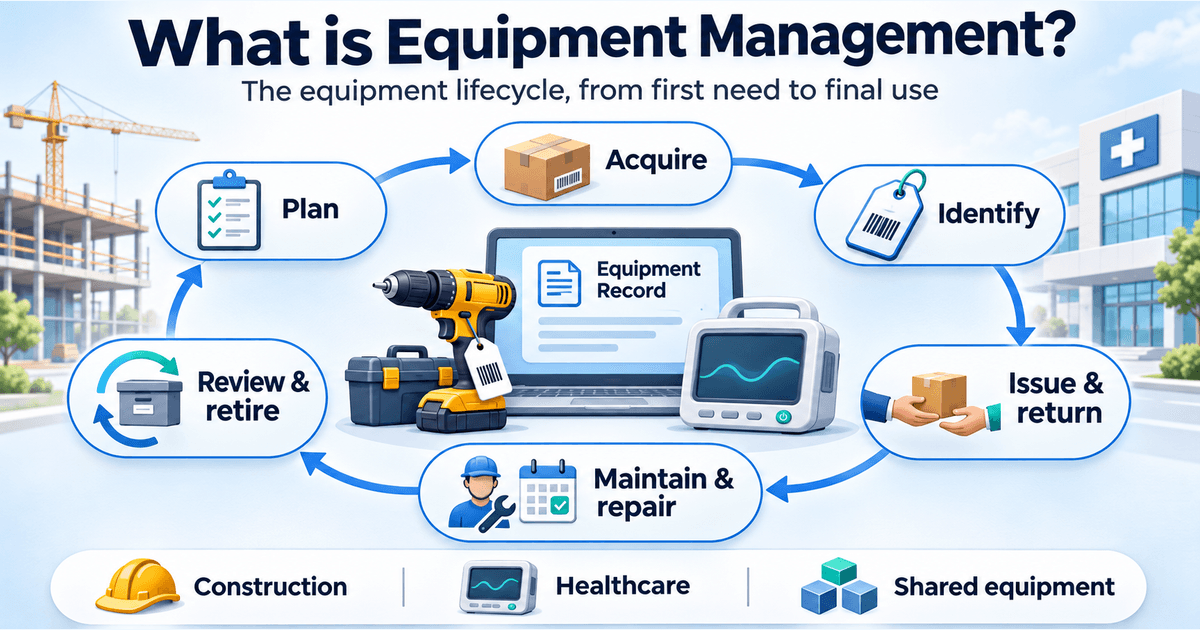
What is equipment management? It is the process of deciding what equipment an organisation needs, keeping track of individual items, assigning responsibility, maintaining them and deciding when to replace or retire them. It covers the whole equipment lifecycle, from the first purchase decision to the item's final use.
For a team sharing tools, the immediate question might be “Who has the drill?” Tomorrow's question could be “It came back, but can we issue it again?” Equipment management connects those questions so a return, a fault and a maintenance decision do not become three unrelated conversations.
This guide explains the process through EquipLoop's equipment records, assignments, returns and reports. It also covers maintenance planning, construction and healthcare, where specialist requirements extend beyond a general equipment register.
What equipment management covers
Equipment management connects the physical item, the people using it and the decisions needed to keep work moving. An inventory count is a starting point. The ongoing work includes issuing items, recording transfers, investigating damage and checking whether suitable equipment is available before buying more.
itemit's equipment management guide offers a useful starting framework: scope, benefits, getting started and software. Here, we take those subjects into the daily decisions an equipment team makes, using a worked EquipLoop example.
A practical process should help you:
- Identify the exact item involved in a handover.
- Keep its current holder and recorded location understandable.
- Distinguish available equipment from equipment needing attention.
- Connect reported problems with a responsible person and next action.
- Use the item's history when considering repairs, redeployment or replacement.
For the wider discipline, see what asset management means. Equipment management focuses that discipline on the physical items people use to carry out work. A management system adds the policies, roles and processes that organise those activities.
The equipment life cycle from planning to retirement
The equipment life cycle, also written as “equipment lifecycle”, starts before an item arrives. You first need to decide what job it must do and whether existing equipment can meet that need. IBM's equipment management overview similarly treats acquisition, deployment, maintenance, optimisation and disposal as connected activities.
The following is a practical working model, rather than a prescribed set of stages for every industry:
| Stage | Decision to make | Useful information |
|---|---|---|
| Plan and acquire | Buy, lease, hire or redeploy an existing item? | Required task, suitability, support and expected whole-life cost |
| Identify and register | Which physical item have we received? | Equipment description, asset ID, serial number and starting condition |
| Deploy and hand over | Who receives it, and where will it be used? | Named holder, recorded location, issue details and expected return |
| Maintain and repair | What work is needed to keep or restore its function? | Reported faults, inspection findings and the appropriate maintenance plan |
| Review and redeploy | Does the item still meet the team's needs? | Availability, condition, demand, repair costs and operational experience |
| Retire and replace | Should it leave service, and what replaces it? | Reason for retirement, approval and the appropriate final disposition |
Maintenance runs alongside use; it is not a one-off stage after deployment. Likewise, reviewing demand can lead to redeployment rather than a new purchase. Keep finance involved in accounting and depreciation decisions while the operational record explains what happened to the item.
Four different facts in an EquipLoop equipment record
One of the easiest mistakes is to use a single description such as “returned” for several different facts. EquipLoop separates the equipment definition from its physical units, and records each unit's status and condition.
| Fact | Example | What it tells you |
|---|---|---|
| Equipment definition | Cordless drill, a particular manufacturer and model | What kind of equipment it is |
| Physical unit | Asset tag DRL-014 with its own serial number | Which individual drill is involved |
| Status | Assigned, available, maintenance, lost or retired | Its recorded operational position |
| Condition | New, good, fair, poor or damaged | Its recorded physical condition |
Custody adds another fact: who currently holds that unit. Location answers where it was recorded. Two identical drills can share the same equipment definition while having different holders, conditions and histories.
This matters when someone asks for a replacement. “We own two drills” does not tell the storekeeper whether either one is suitable and available for the next job. An assignment also shows responsibility, not how many hours the drill actually ran.
An EquipLoop example with two drills and one damaged return
Imagine a small installation company in South Africa sharing two identical drills. This is an illustrative example written for this guide, not a customer case study.
DRL-014 is issued to one technician and DRL-015 to another. Each has its own asset tag, serial number, assignment and expected return. The two technicians bring them back on the same afternoon, but the returns need different outcomes.
| Event | What the team records in EquipLoop | What the manager learns |
|---|---|---|
| Issue DRL-014 | Named recipient, issue condition and expected return | Who is responsible for this drill |
| Issue DRL-015 | A separate assignment against the second unit | The model name alone cannot identify the holder |
| Return DRL-014 in good condition | Return details and condition | Its assignment is closed and its status becomes available |
| Return DRL-015 as damaged | Return condition and a description of what needs attention | Its assignment is closed, its status becomes maintenance and a condition report is created |
| Review the next day's work | Check available equipment and items needing attention | One returned drill is available; the other needs a separate assessment and maintenance decision |
In EquipLoop's individual-unit return workflow, selecting poor or damaged requires a description of what needs attention. Completing that return moves the unit to maintenance rather than putting it straight back into available equipment.
That status change records a problem; it does not schedule a technician or prove that a repair has been completed. The manager must arrange the appropriate work and record subsequent changes. Even an “available” label is an operational record, not a substitute for required checks before use.
This is a useful test of your own process: after two returns, can a second authorised user explain which exact item can be considered for the next issue and which needs follow-up? If the answer depends on a private message to the storekeeper, part of the process still lives outside the record.
For handovers between crews and sites, see how to know who has your construction equipment.
What do equipment managers do?
Equipment managers coordinate the records, people and decisions around equipment. Depending on the organisation, this may be a dedicated role or shared between stores, operations, IT, maintenance and finance.
Their responsibilities commonly include confirming needs, organising the register, overseeing issues and returns, following up on outstanding items, arranging appropriate inspections or repairs and proposing replacements. They also agree who may update records and how staff report faults.
The manager does not need to perform every technical task personally. For example, an administrator can coordinate a repair while a competent technician diagnoses and completes it. The important handover is knowing who owns the next action.
A daily review routine using EquipLoop reports
Here is a suggested routine using reports already available in EquipLoop:
- Check Current assignments. Follow up on expected returns that affect today's work. An overdue assignment calls for confirmation, not an automatic conclusion that an item is lost.
- Check Available equipment. Identify possible items for upcoming issues, then confirm suitability and any required checks.
- Check Needs attention. Review overdue, poor, damaged, maintenance and lost equipment. Give each exception a practical next action.
- Use Movement history when something disagrees. Review issues, returns, transfers and state changes before correcting the current record.
For example, if a worker says a drill was passed to a colleague, compare the account with its recorded history. Confirm the handover and use the supported transfer or correction process. The report helps you ask a better question; it cannot recover an event nobody recorded.
What are the three types of equipment maintenance?
Three commonly used approaches are reactive, preventive and predictive maintenance. NIST describes these approaches in manufacturing. They are a useful introduction, not the only possible classification.
| Approach | What triggers the work | Example |
|---|---|---|
| Reactive maintenance | A failure or breakdown | Arrange repairs after a tool stops working |
| Preventive maintenance | A planned time or usage interval | Perform the manufacturer's specified service when due |
| Predictive maintenance | Analysis of condition or performance data | Investigate an emerging fault indicated by monitored machine behaviour |
You may also encounter corrective maintenance, meaning work to fix an identified defect. It can be planned after an inspection rather than waiting for a complete breakdown, as IBM's maintenance scheduling guide explains.
Maintaining equipment matters because deterioration can affect availability, performance and suitability for use. The right maintenance approach depends on the item, how it is used and the consequences of failure. A condition note in a register does not provide the measurements or analysis needed for predictive maintenance.
What should a maintenance plan contain?
A usable maintenance plan connects the task to the exact equipment and the people responsible. Include:
- Identity and instructions: asset ID, model and the relevant manufacturer procedure.
- Trigger: the applicable time, usage or inspection requirement.
- Responsibility: who coordinates the work and who is competent to perform it.
- Resources: access to the equipment, suitable tools, parts and required precautions.
- Completion evidence: work performed, findings, unresolved faults and supporting service records.
- Return to use: who confirms the required checks and how the record is updated.
Planning establishes the work and resources; scheduling allocates the time and people. Use the equipment's instructions and appropriate technical expertise to set tasks and intervals. A generic blog checklist should not become a repair procedure.
How equipment management changes by industry
Construction equipment management
Construction teams often need to distinguish the person holding an item from the site where it is being used. A drill can move between workers without leaving the site, or travel to another site with the same worker. Those are different record changes.
Capture accessories and condition at handover, and record transfers that happen without a return to the store. Our construction equipment guide explains a complete custody example. Equipment needing inspections, servicing or specialist operation also requires the relevant technical process alongside those records.
Medical equipment lifecycle management
In healthcare, medical equipment lifecycle management extends from selection and installation to training, maintenance and retirement. Biomedical equipment may also need calibration, performance verification and checks after repairs, depending on the device and its use. WHO's laboratory equipment guidance connects these activities with documented responsibilities and manufacturer instructions.
A record can help identify a particular monitor or laboratory instrument, but a general equipment tracker does not establish clinical readiness. The organisation's clinical engineering or biomedical team must govern the applicable servicing, testing and release-to-use procedures. EquipLoop's condition and status fields should not be treated as a medical-device maintenance programme or certification.
WHO's inventory and maintenance information systems publication is further reading for healthcare teams evaluating specialist requirements.
Manufacturing, media and education
A manufacturing team may prioritise machine availability and maintenance windows. A film crew may need the correct camera, lens and accessories back before another booking. A school may manage reusable sports equipment across teams and terms. The equipment record supports these activities, while the required technical checks and scheduling tools depend on the work.
Ten examples of equipment you can manage
Equipment is a broad description of the items used to perform a task. These examples illustrate different management questions, not a universal classification:
| Equipment example | A useful question to answer |
|---|---|
| Laptop | Which employee currently holds this unit? |
| Cordless drill | Which physical drill was returned? |
| Laser level | Did its case and accessories come back? |
| Generator | Is it available for the next job? |
| Two-way radio | Who received it at the start of the shift? |
| Forklift | Who coordinates its servicing and authorised use? |
| Camera | Which body and lens were handed over? |
| Laboratory centrifuge | Where are its required service and verification records? |
| Patient monitor | Which team controls its technical readiness? |
| Reusable sports training kit | What was issued and what remains outstanding? |
Track an item individually when its own holder, condition or history matters. Grouped quantity records can suit interchangeable items where you need a count. Consumable stock, such as drill bits or disposable supplies, may require a different replenishment process.
Equipment software, CMMS and asset management software
Start with the problem you need software to solve:
| Main requirement | Software scope to assess |
|---|---|
| Know who has each item and record issues, returns and condition | Equipment tracking software, including EquipLoop's custody workflow |
| Schedule maintenance, assign technicians and manage repair work orders | A computerised maintenance management system, or CMMS |
| Coordinate wider lifecycle, operational and financial requirements | Asset management software suited to those specific requirements |
These categories overlap, so inspect the actual product and plan. EquipLoop connects equipment records, people, recorded locations, handovers, condition and history. Its maintenance status supports follow-up; it should not be assumed to include a CMMS service scheduler or biomedical maintenance functions.
QR code asset tracking helps an authorised user open the correct record. A QR label does not transmit a live position. RFID or GPS solutions have different hardware and operating requirements; our cheap asset tracking comparison explains the distinctions.
How to start managing equipment with EquipLoop
Begin with one equipment group and test the events your team actually encounters:
- Identify the physical items and give individually tracked units permanent asset IDs.
- Create their records and confirm starting condition, location and current responsibility.
- Label the units so similar items can be distinguished at handover.
- Record an issue with a named recipient and expected return where relevant.
- Test a person-to-person transfer and a normal return.
- Test a poor or damaged return and agree who handles its maintenance follow-up.
- Review the reports and ask another authorised user to explain each item's current position.
Our equipment register setup guide provides sample fields and a CSV if you need to organise an existing list first. For shared handovers, explore EquipLoop's equipment management software and check the current plan features.
Common questions about equipment management
What is an equipment manager?
An equipment manager is the person responsible for coordinating equipment availability, records, custody and upkeep. They may work with operators, stores, technicians and finance rather than doing every purchase, inspection or repair themselves.
What are the four types of equipment?
There is no single four-type classification covering every industry. You could group equipment by purpose, such as office/IT, construction, medical/laboratory and production equipment, but those are examples of useful categories. Choose groups that support your reporting and working procedures.
How do you manage sports equipment?
Separate items needing individual identities from items managed by quantity. Record who receives each item or kit, the expected return and its condition. Reconcile the return and arrange the sport-specific cleaning, inspection or replacement process before reissue. Do not assume that a general equipment record certifies protective gear as suitable.
What are the responsibilities of an equipment operator?
Operators use equipment within their training and authorisation, complete the applicable checks, report faults and follow the handover process. Managers coordinate the wider records and resources. The exact duties depend on the equipment, workplace procedures and role.
What are five basic maintenance skills?
Useful foundations include following technical instructions, recognising and describing faults, performing authorised inspections, keeping accurate records and communicating when specialist help is needed. These are practical skills, not a universal qualification standard. Technical servicing requires competence appropriate to the equipment and task.
References and further reading
The two-drill example and suggested EquipLoop review routine were written for this guide. The wider context draws on:
- itemit: Equipment management, for scope, benefits and getting started.
- IBM: What is equipment management?, for the equipment lifecycle and management context.
- NIST: Machinery maintenance approaches, for reactive, preventive and predictive maintenance.
- IBM: Maintenance scheduling, for the relationship between planning, scheduling and corrective work.
- WHO: Laboratory equipment management module, for equipment oversight, maintenance and verification in laboratory settings.
- WHO: Inventory and maintenance management information system for medical devices, published in 2025, for further healthcare-specific reading.
PUT IT INTO PRACTICE
Give every piece of equipment a clear record.
Track who has it, where it is and what happened to it. Start your asset register with EquipLoop.
Start tracking for free