 EquipLoop
Asset management basics / THE EQUIPLOOP JOURNAL
What Is Asset Management? A South African Business Guide
Learn what asset management means, how it works and how South African businesses can track equipment, manage asset lifecycles and build a useful asset register.
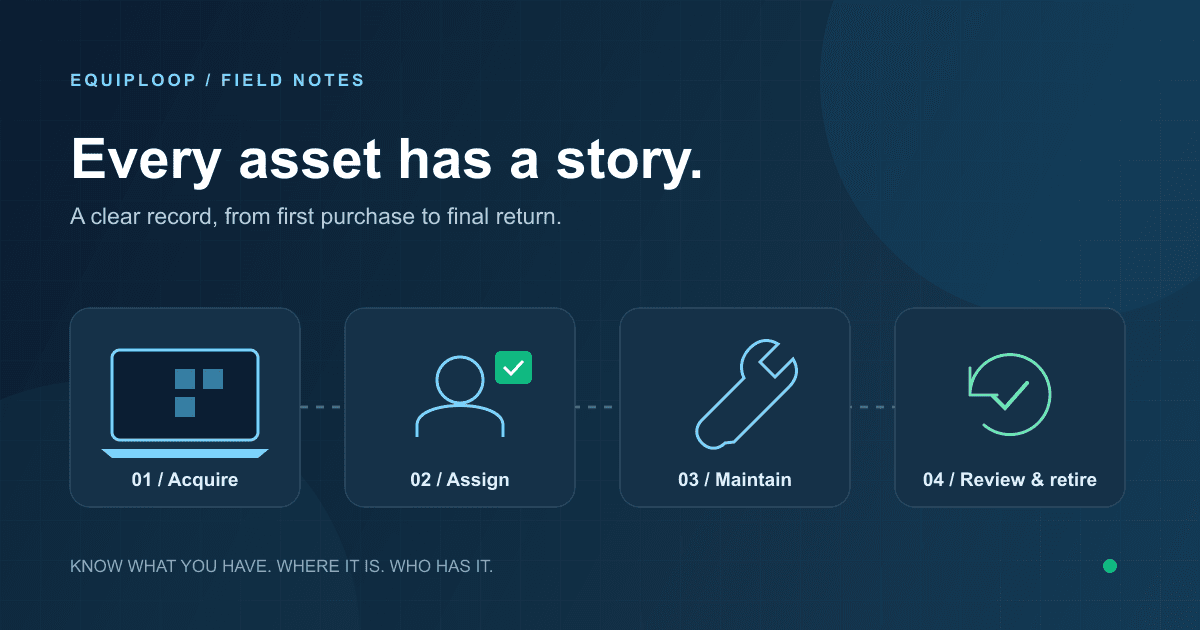
Asset management means making organised decisions about assets so they deliver value throughout their useful lives. For a business, that includes deciding what to buy, recording what it owns, assigning equipment, looking after it and planning its replacement.
The term also describes managing investment portfolios. A fund manager may think about shares and bonds; an operations manager may think about laptops, tools and vehicles. Both care about value and risk, but their day-to-day work is different.
This guide explains the distinction, then focuses on physical asset management for South African businesses: the equipment people use to do their jobs.
What is asset management in simple terms?
Asset management is looking after things that have value to an organisation, with a plan for how they are acquired, used and eventually replaced or retired. The aim is to get useful service from those assets while making sensible decisions about cost, performance and risk.
The Institute of Asset Management describes the discipline in terms of balancing costs, opportunities and risks against the performance an organisation needs. That is broader than a list of possessions: it connects asset decisions to business objectives.
For an equipment team, start with five questions:
- What do we own or control?
- Where is each item?
- Who is responsible for it?
- What condition is it in?
- Should we keep using it, repair it or replace it?
An accurate record helps answer these questions. A working process makes sure the answers stay current.
Financial vs physical asset management
There are two common meanings behind the search “what is asset management”. Understanding the context prevents confusion.
| Area | Assets involved | Typical work | Main purpose |
|---|---|---|---|
| Financial asset management | Shares, bonds, cash and investment funds | Research investments, select holdings, monitor portfolios and rebalance | Pursue investment goals within an agreed level of risk |
| Physical or business asset management | Equipment, vehicles, machinery, buildings and infrastructure | Record assets, assign responsibility, maintain them and plan replacement | Keep assets useful and support business operations |
In finance, asset managers invest and manage wealth for individuals and organisations. Nordea's explanation outlines how investment decisions balance potential returns against risk. The South African Holborn Assets article also approaches the subject through financial planning.
For a contractor issuing power tools or an IT team issuing laptops, the useful starting point is physical asset management. Investment portfolio software and an equipment tracking system serve different needs.
What assets can a business have?
Businesses can have physical, financial and intangible assets. Examples include a delivery vehicle, cash, software rights or a brand. These categories can overlap with other classifications, so there is no single universal list of “four asset types”.
Five practical examples of physical business assets are laptops, mobile phones, power tools, vehicles and office furniture.
In a South African workplace, the equipment register might also include radios issued to security officers, machinery used in a workshop, or reusable protective equipment issued to a field team. Lower-cost items may still need operational tracking even when the finance team does not treat them as capital assets.
Useful related terms include:
- IT asset management: managing hardware and software through their lifecycles. Laptop allocation is one part of this; software licences and IT governance introduce other requirements.
- Fixed asset management: keeping records and control of longer-term business assets, often with finance involved in valuation and depreciation.
- Enterprise asset management: coordinating physical assets across an organisation, often with extensive maintenance and work-order processes.
These terms describe different scopes. Choose the process that matches the assets and decisions your team handles.
An example of asset management in South Africa
Consider an illustrative electrical contractor in Gauteng with technicians working across several customer sites. The company buys a drill for R3,500 and gives it to a technician.
Without a reliable handover record, the next supervisor may not know who has that drill. Buying another one could be unnecessary if the first is sitting in a vehicle or storeroom.
A practical asset management process would:
- Create a record with a unique asset ID, description, serial number and purchase details.
- Label the drill so the physical item can be matched to its record.
- Record the technician receiving it, the issue date and its condition.
- Update the record when the drill moves to another person or site.
- Capture damage or service needs and decide whether it remains suitable for use.
- Record its return, repair, reassignment or eventual retirement.
The drill's useful history now follows the item. The purchase price is only one part of its cost: servicing, unavailable working time and replacement also matter. This is an example, not a claim about measured savings.
The same approach works for a Cape Town office handing over laptops or a Durban field-service team sharing tools. Start with an equipment issue register if accountability at handover is the immediate problem.
How does the asset management lifecycle work?
An asset lifecycle is the journey from identifying a need to retiring the asset. The stages below are a practical starting framework rather than a prescribed standard.
| Stage | Decision or action | Record to keep |
|---|---|---|
| Plan | Decide what is needed and check existing equipment first | Purpose, required specification and responsible team |
| Acquire | Purchase or obtain the item | Supplier, purchase date, cost and supporting documents |
| Register | Identify the item and establish its starting record | Asset ID, serial number, location and condition |
| Assign and use | Issue it to a person or place it into service | Holder, handover date and movements |
| Maintain and review | Inspect, service or repair it where needed | Condition, service history and issues requiring attention |
| Return, replace or retire | Decide its next use or remove it from service | Return details, reason for retirement and final action |
Asset tracking supports the lifecycle; it does not replace every part of asset management. Knowing who has a generator is useful. Deciding its servicing interval or whether it can meet a site's power needs requires additional operational judgement.
What do asset managers actually do?
People responsible for physical assets keep records accurate, coordinate with users and help make decisions about the equipment. In a small company, the work may be shared by an office administrator, an IT lead, a supervisor and finance.
Daily responsibilities can include checking overdue returns, recording new items, confirming transfers, following up on damaged equipment and checking that assets recorded at a location are actually there. Longer-term work includes reviewing utilisation, planning replacement and coordinating maintenance.
Useful skills include attention to detail, clear communication, familiarity with the equipment and the ability to interpret records. The role is broader than data entry: someone must act when the records show a problem.
In financial asset management, daily work instead centres on investment research, portfolio decisions and monitoring performance. That is a different career path from managing company equipment.
Asset management vs asset tracking vs inventory management
These processes are related, but they answer different questions.
| Process | Main question | Workplace example |
|---|---|---|
| Asset management | How do we get value from assets over their lifetimes? | Decide whether to service or replace an ageing drill |
| Asset tracking | Where is the item and who has it? | Find the technician assigned drill TOOL-042 |
| Inventory management | What stock do we have and when should we replenish it? | Count drill bits, cable and other consumable supplies |
An individually tracked drill is usually managed differently from a box of replaceable drill bits. A business can need both equipment records and stock controls.
Finance may also maintain a fixed asset register for accounting purposes. An operational equipment register focuses on current holders, locations, condition and movements. The records should agree where they refer to the same item, but one does not automatically replace the other.
Why asset management matters for South African businesses
When equipment moves between offices, storerooms and customer sites, relying on memory quickly becomes difficult. A consistent process helps teams:
- Reduce avoidable purchases: check whether suitable equipment is already available before ordering more.
- Improve handovers: make responsibility visible when someone receives, transfers or returns an item.
- Respond to problems: identify equipment with reported damage or repeated issues.
- Plan replacements: review condition and history rather than waiting for an unexpected failure.
- Support record checks: compare the register with physical items and investigate differences.
The benefit comes from keeping records current and using them to make decisions. Software cannot make an unrecorded transfer visible on its own.
What are the risks in asset management?
For physical assets, common risks include missing equipment, inaccurate records, unsuitable use, unexpected failures and unclear responsibility. A register that nobody updates can give a misleading picture of what is available.
Practical controls include a unique identifier for each tracked item, a named responsible person, recorded issue and return events, routine physical checks and a clear way to report damage. Maintenance-critical equipment also needs an appropriate inspection and servicing process.
A QR label helps identify an item and open its record. It does not provide continuous GPS location or automatically prove that the item is still at its recorded site.
How to start an asset register
Begin with one equipment category or location. A small, reliable register is more useful than a large file that nobody trusts.
- Agree on scope. Decide whether you are tracking laptops, tools, reusable PPE or another group of equipment.
- Verify the items. Check what physically exists and remove duplicate records.
- Set consistent fields. Use the same names for categories, sites and conditions.
- Give each tracked item an ID. Keep its manufacturer serial number as a separate field.
- Record current responsibility. Capture the holder or location and confirm it with the team.
- Define updates. Decide who records purchases, issues, transfers, returns and retirement.
- Review regularly. Compare records with physical items and resolve discrepancies.
A useful starting register includes asset ID, description, category, serial number, location, current holder, status, condition and issue or return dates. Purchase and service information can be added where relevant to your process.
Use an equipment handover form to make the first assignment clear. For laptop teams, see laptop asset tracking software.
What is asset management software?
Asset management software brings asset records and related workflows into a shared system. The features vary: some products focus on equipment assignments, while others include work orders, maintenance scheduling, accounting or enterprise planning.
For everyday equipment tracking, look for a central register, unique item records, person and location assignments, condition updates, issue and return history, and useful reporting. If your team needs specialist servicing or accounting functions, check those requirements separately.
EquipLoop focuses on the operational tracking side: equipment records, people, locations, assignments and history. QR code asset tracking makes it easier to open the correct record from the item itself. See how EquipLoop tracks equipment for the product workflow.
Frequently asked questions
What falls under asset management?
It can cover planning, acquisition, records, use, responsibility, maintenance, risk and retirement. The scope depends on the assets involved. Managing an investment fund and managing a workshop's equipment require different processes.
What is another name for asset management?
Related terms include equipment management, fixed asset management, IT asset management and enterprise asset management. They are useful descriptions of a particular scope, rather than exact replacements for the broader term.
What are the two main types of assets?
It depends on the classification. Tangible and intangible describe whether an asset has physical substance. Current and non-current are accounting categories. Financial and physical asset management describe two common contexts for the management work.
Can a small business use a spreadsheet for asset management?
Yes, a spreadsheet can be a practical starting register if someone maintains it and records handovers consistently. A shared system becomes useful when several people update equipment records, items move frequently or finding their history becomes difficult.
What is an example of an asset manager?
In an equipment context, an IT manager coordinating laptop assignments and returns performs asset management work. In finance, an investment manager responsible for a client's portfolio is an asset manager. The title alone does not identify the type of assets involved.
Is asset management only for large companies?
No. A small business issuing equipment to a few employees still benefits from knowing what it has and who is responsible for each item. The process should match the team's size and needs.
Sources and further reading
- Institute of Asset Management: What is asset management? — the broad discipline, value and lifecycle decisions.
- Nordea: What is asset management? — the financial meaning and investment portfolios.
- Holborn Assets South Africa: Asset management in financial planning — the financial planning context in South Africa.
The equipment scenarios and starting checklist in this guide are illustrative examples written for business teams.
PUT IT INTO PRACTICE
Give every piece of equipment a clear record.
Track who has it, where it is and what happened to it. Start your asset register with EquipLoop.
Start tracking for free